Driveway edging, kerbs and boundary walls
What holds the paving in and finishes the frontage. Structurally the most important metre of a driveway, and visually the part people actually notice.
- Laying driveways since 1977
- Over 45 years’ experience
- Which? Trusted Trader
- Fully insured
- 30+ 5-star reviews
Is your driveway spreading, or your front wall falling apart?
Two different problems live on the perimeter of a driveway, and they usually arrive together.
On the structural side, the edges have started to creep. The joints along the boundary have opened, a soldier course has tipped outwards, blocks rock underfoot at the perimeter, and the whole field of paving looks very slightly wider than it used to be. That is an edge restraint that has failed or was never haunched properly, and until it is rebuilt anything done to the middle of the drive will slowly undo itself.
On the visible side, the front wall has had it. Mortar crumbling, coping gone, a section knocked out years ago for a crossover and never properly finished, or piers that were never rebuilt after the last driveway went in. A beautifully paved frontage behind a wall in that condition still reads as a tired frontage from the pavement.
It usually shows up as one of these:
- The edges are creeping outwards. Widening joints at the perimeter, blocks tipping, the paving losing its interlock from the outside in.
- The entrance has sunk. Settlement across the threshold, where every vehicle crosses and where restraint is most often skimped.
- The front wall is failing. Crumbling mortar, missing coping, or a stump left where a section was removed and never closed off.
- The frontage looks unfinished. A gap where a wall used to be, or piers that do not match the pair next door.
Both halves are fixable, and they are usually best fixed at the same time.
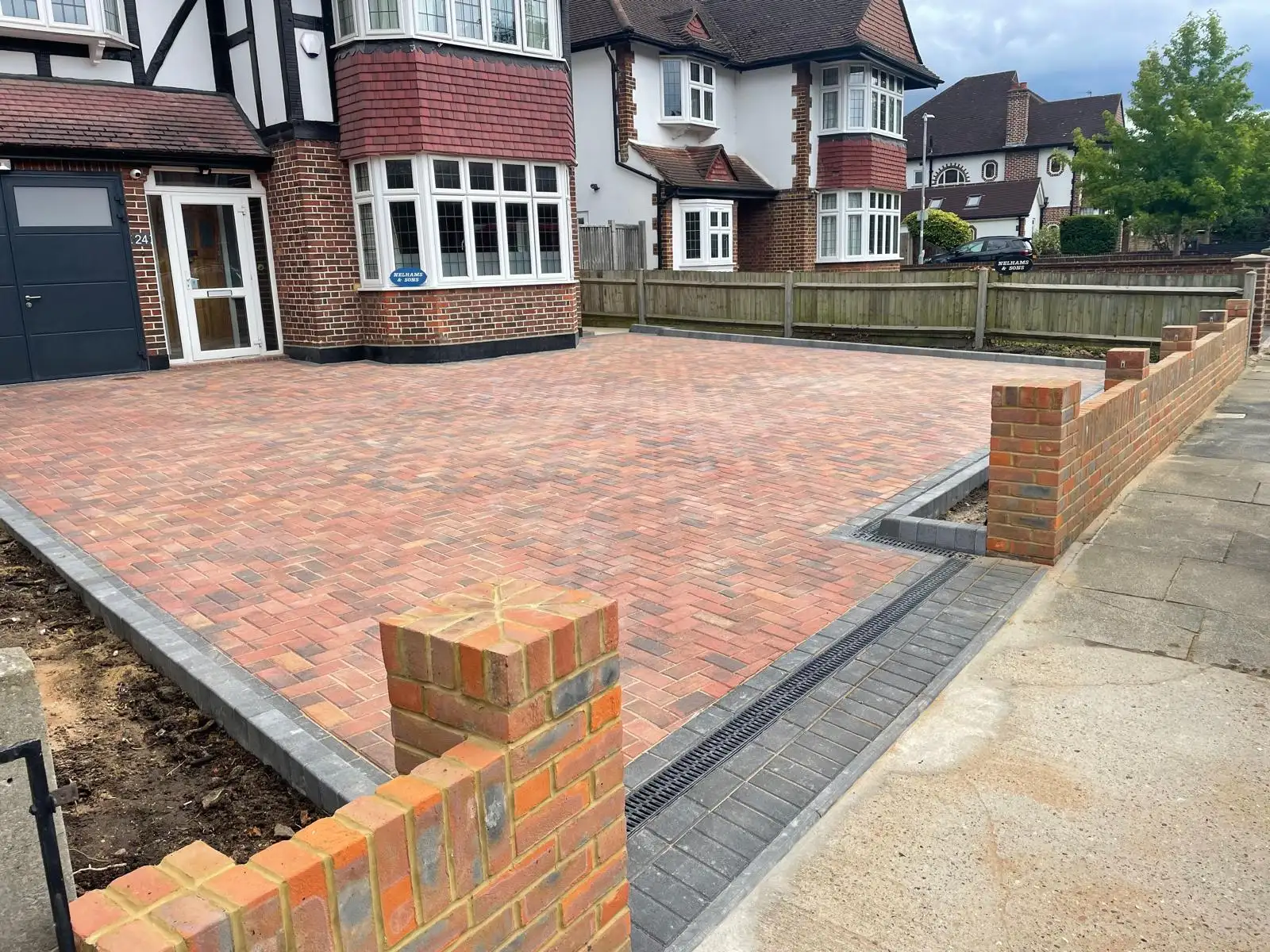
Twin charcoal border, rebuilt boundary wall with piers, and the channel drain running along the entrance where the load is heaviest.
A frontage that holds together and looks finished
We rebuild the edge restraint so the paving stops moving, and rebuild the boundary so the front of the house looks deliberate rather than interrupted.
The restraint is a kerb, edging or soldier course bedded on a concrete foundation and haunched, which means concrete brought up behind it to hold it against the outward push of the paving. Haunching is the part that gets skipped, because it is below ground and nobody will ever see whether it was done. It is also the part that decides whether the edge holds.
Above ground, the boundary is doing real work on most Twickenham roads. It separates the frontage from a busy pavement, it gives the house a front to speak of, and on a great many streets the rhythm of low walls and piers is a large part of what the road looks like. Which is why taking one out entirely is usually the wrong instinct.
- Edge restraints bedded on concrete and properly haunched behind
- Entrance aprons where the load is heaviest, to take the wear
- Low front walls in brick matched as closely as we honestly can
- Piers and caps, matched to the pair next door where that suits
- A section opened up for a crossover, with the ends closed properly
- Retaining walls where the frontage falls away to the footway
Edge restraints, and why they fail
The failures we are called to look at are consistent:
- Edging bedded on sand. It moves within a couple of winters and takes the paving with it.
- Concrete under it but no haunch behind it. The unit rotates outwards at the top. You see this as a soldier course that has tilted.
- The haunch stops short of the entrance. The entrance carries the most load of any part of the drive, and it is where restraint is most often skimped.
- No restraint at all against a lawn or border. Very common on driveways that were widened at some point without rebuilding the perimeter.
Ways to restrain an edge
- Concrete kerb or edging. The workhorse. Economical, strong, and disappears against a border.
- Soldier course. Blocks laid on end in a contrasting colour. Structural and decorative at once, and the most common choice on a driveway.
- Brick-on-edge in a matching brick. Where the driveway meets a period house and a concrete kerb would look wrong.
- Granite or conservation kerb. Where the street scene calls for it, or in a conservation area.
- Full entrance apron. A band of contrasting paving across the threshold, taking the wear at the busiest point.
Front boundary walls
Removing a front wall entirely to create a driveway is often the wrong instinct. Taking out a section for the crossover and rebuilding the ends into proper piers keeps the street rhythm and frames the entrance. It also looks finished rather than interrupted.
What we build
- Low front walls in brick, matched as closely as we can to the house
- Entrance piers, with brick, stone or precast caps
- Rebuilding and re-capping existing walls that have failed
- Taking out a section for a new crossover and closing the ends properly
- Retaining walls where the frontage falls away to the footway
- Steps and thresholds where the levels need resolving
Where a frontage slopes down to the pavement, which happens on a number of roads around East Twickenham and the river, the wall may be retaining ground rather than simply dividing it. That is a different construction with a proper foundation and drainage behind it, and it needs to be built as one.
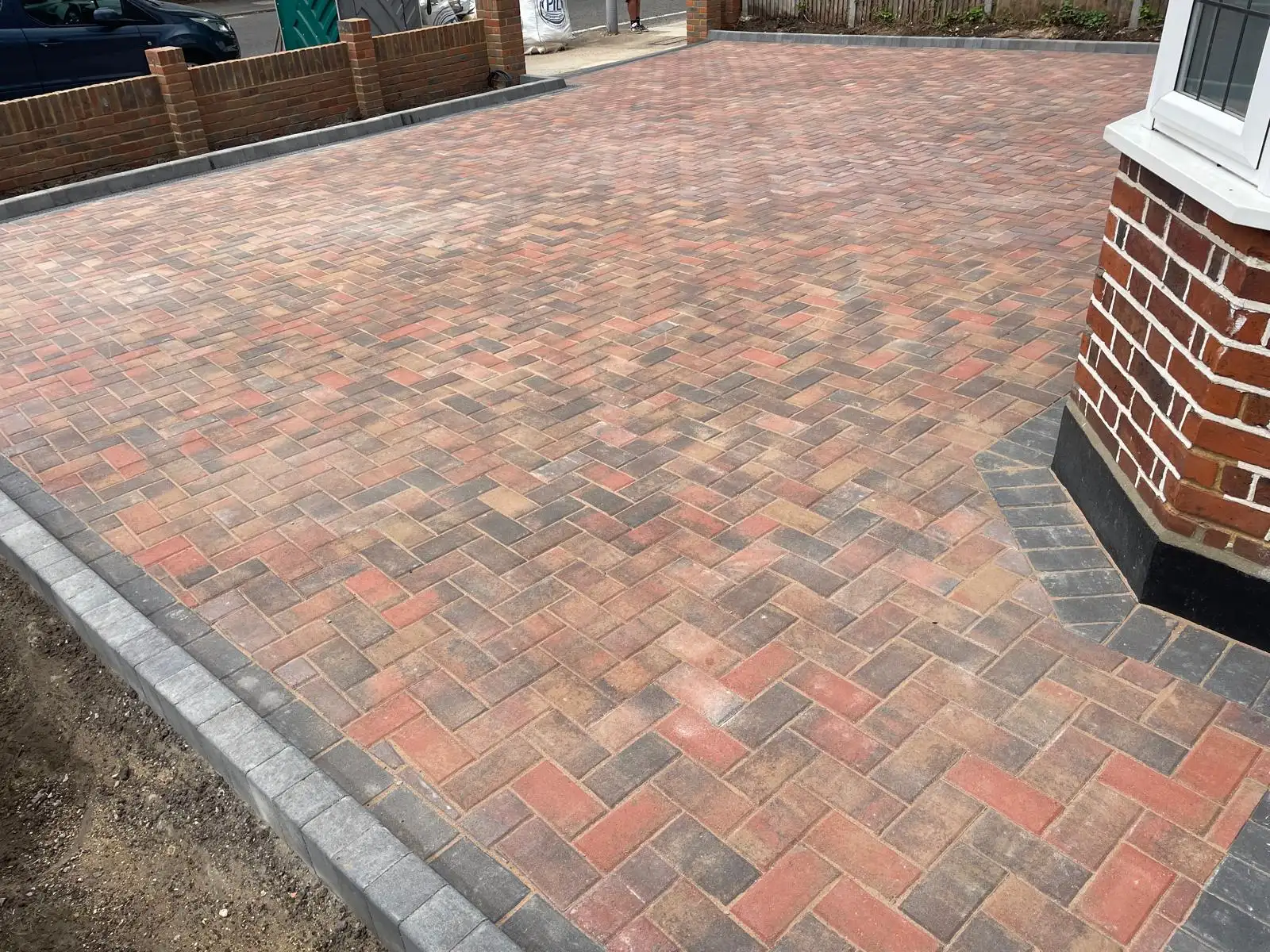
Wall and piers rebuilt as part of the driveway rather than left over from it.
The front boundary wall is frequently the element the council protects most firmly, sometimes more than the paving. Richmond upon Thames has more conservation areas than any other London borough. Check before you demolish anything. What needs permission.
How simple it is to get your frontage put right
Three steps, and a picture of the street helps more than you would think.
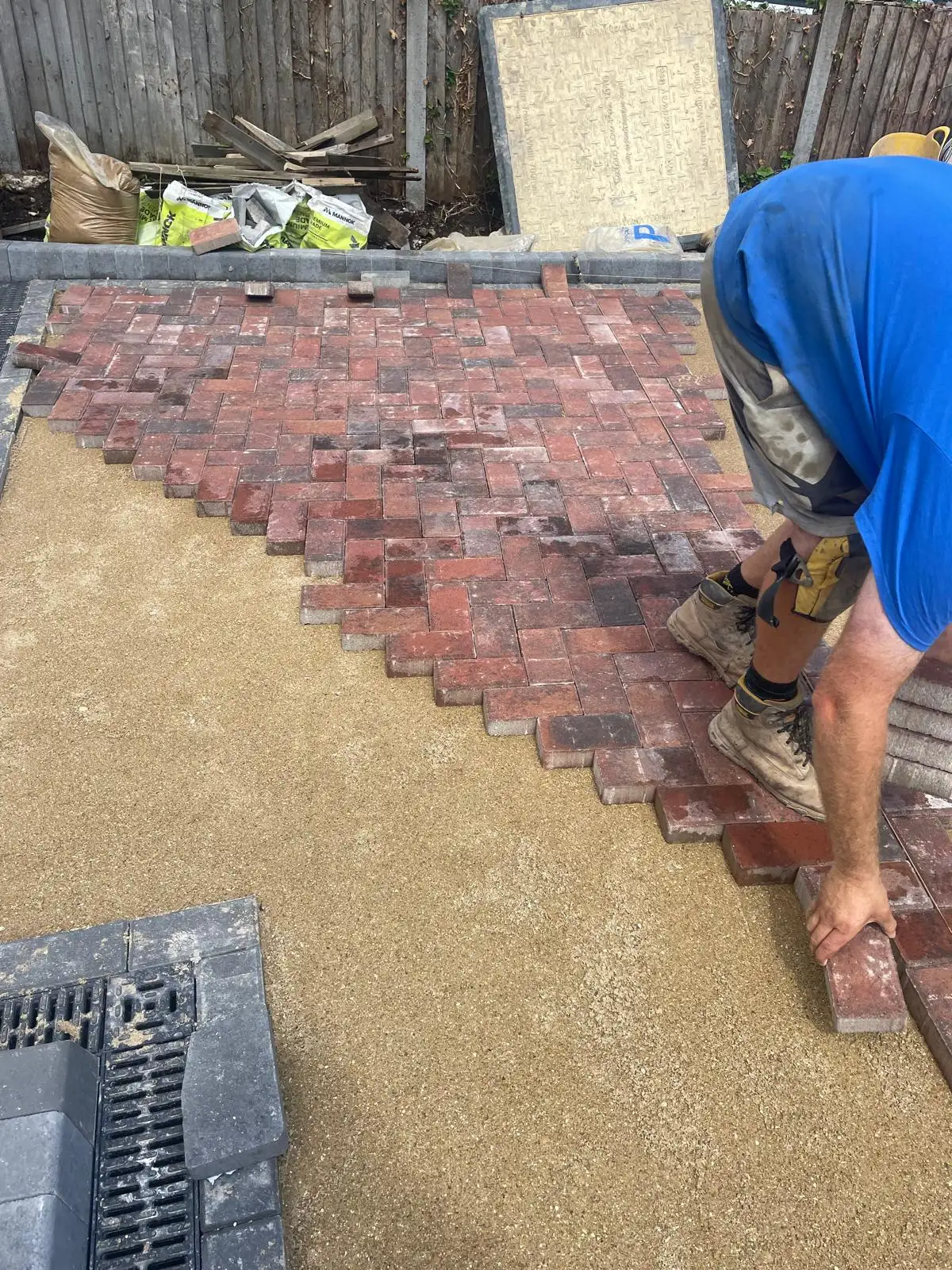
Step three. The edge course bedded and haunched before a single field block goes down, because the restraint has to be there first.
Tell us what the frontage looks like now
Whether the paving is creeping, whether the wall is failing, and what you would like it to look like. Mention if you are trying to match a neighbour or a pair of semis, because that changes the detailing. We reply within 24 hours.
We come and look, and you get a written quote
We check whether the existing restraint was ever haunched, look at how the wall is built and whether it is retaining ground, and check the levels at the entrance. Brickwork and paving are priced separately so you can see what each costs.
We build it, and clear up properly
Edging and walling is typically two to four days depending on how much brickwork is involved. Everything goes off site and the footway is swept at the end of each day.
Why trust us with the edges and the brickwork
Edging is the cheapest thing to skimp on and the most expensive thing to get wrong, because when it fails it takes the whole driveway with it.
Because we haunch, not just bed
Concrete under the unit and concrete brought up behind it. Bedding alone lets the restraint rotate outwards under the push of forty square metres of paving, and nobody will ever see whether it was done — which is exactly why it gets skipped.
Because we restrain the entrance properly
The threshold takes the most load of any part of the drive and it is where haunching most often stops short. It is also where settlement shows up first. We build it as the hardest-working metre on the job, because it is.
Because we are honest about brick matching
A century-old London stock has weathered into something no new brick replicates on day one. We will get close, we will match the mortar and the joint profile, and we will tell you when reclaimed brick is worth the money.
Because we know the wall is often what the council cares about
In a conservation area the front boundary treatment is frequently protected more firmly than the paving. We raise that before anything is demolished, not after.
Because we think about the street, not just the plot
On a semi, your frontage and your neighbour’s read as one elevation. Matching wall height, pier detail and cap makes both houses look considered. It costs nothing to think about at the design stage and cannot be retrofitted.
Because we have been laying and walling since 1977
Bricklaying and block paving are two trades. We do both, so the wall and the driveway are built by the same firm to the same levels, and there is one person to come back to.
Edging and walling questions
Does a block paved driveway really need an edge restraint?
Yes, without exception. Block paving is a flexible pavement: it carries load by the blocks locking against each other. Take away the restraint at the perimeter and the outer blocks have nothing to push against, so they migrate outwards under traffic. The joints open, the interlock is lost, and the failure works inwards from the edge.
A restraint bedded on and haunched with concrete is not a decorative choice. A driveway without one has a shortened life built into it from day one.
Can you match the brick on my house?
Usually to a good standard, though rarely perfectly, and we would rather set that expectation honestly. London stock brick weathers over a century into something no new brick replicates on day one.
What we can do is get close on colour, texture and size, use a matching mortar and joint profile, and reclaim bricks where the budget allows. On a period frontage the mortar and the pointing style often matter more to the eye than the brick itself.
Do I need permission to remove my front wall?
Sometimes. Under permitted development you can generally build or alter a front boundary wall up to one metre next to a highway without permission. Removing one is usually fine too.
But in a conservation area, or where an Article 4 direction applies, the front boundary treatment is often specifically protected, and Richmond upon Thames has more conservation areas than any other London borough. On some Twickenham roads the wall is the element the council cares most about. Check before you knock it down. See our planning guide.
What is an entrance apron and do I need one?
An apron is a band of paving, often in a contrasting block or a different pattern, laid across the entrance where the driveway meets the footway. It is the most heavily trafficked strip on the whole drive, because every vehicle crosses it at an angle.
You do not strictly need one, but it earns its place: it gives the edge restraint somewhere to be at the busiest point, it takes the wear, and it visually resolves the join between your paving and the public footway.
Can you build the piers to match the ones next door?
Often yes, and on a semi it is usually worth doing. Matching the pier detailing, the cap and the wall height across a pair of semis makes both frontages look considered, whereas a mismatched pair draws the eye immediately.
Tell us what you are trying to match when you get in touch, or we will look at it when we visit.
Can you do the walling without doing the driveway?
Yes. Rebuilding a failing front wall, forming new piers, re-capping or opening up an entrance are all jobs we do on their own, and they are frequently worth doing before the paving rather than after.
Where the wall is retaining ground, or where opening it up changes the levels at the entrance, we will talk through how that interacts with whatever surface is going down later so the two do not fight each other.
Tell us what the frontage looks like now
Tell us about your driveway and your plans. We’ll get back to you within 24 hours.
Describe the wall and what has happened to it, and whether the paving is moving at the edges.
If you are trying to match a neighbour or the other half of a pair of semis, mention that too — it changes the detailing.
- We come out and look at it properly
- Written, itemised quote
- No obligation and no chasing afterwards