Lifting and re-laying block paving
When the blocks are sound but the base underneath them never was, taking it up and doing it properly costs a great deal less than starting again.
- Laying driveways since 1977
- Over 45 years’ experience
- Which? Trusted Trader
- Fully insured
- 30+ 5-star reviews
Are your blocks still good, but the driveway isn’t?
There is a particular kind of driveway we get called to a lot. Ten or fifteen years old, blocks in genuinely decent condition, and the whole surface rutted, uneven and ponding in two places.
You have probably already worked out that the blocks are not the problem. They look fine when you clean one. And yet the drive is dipping where the wheels sit, water gathers in the same two spots, the edges have crept out and nothing lines up any more.
Which puts you in an awkward position. Repairing one patch feels like it is treating a symptom. Replacing the whole thing feels like throwing away several thousand pounds of perfectly good paving. Neither is obviously right, and nobody has explained the option in between.
You are probably looking at a re-lay if:
- It is failing in more than one place. One dip is a local problem. Three or four means the base was never right anywhere.
- You have already had it patched. And the repair held, but something else went a year later.
- The blocks are fine. Sound, unbroken, and a colour and pattern you are happy with.
- You cannot match them anyway. Discontinued range, so replacing part of it would never look right.
That driveway does not need new blocks. It needs the ground under it rebuilt.
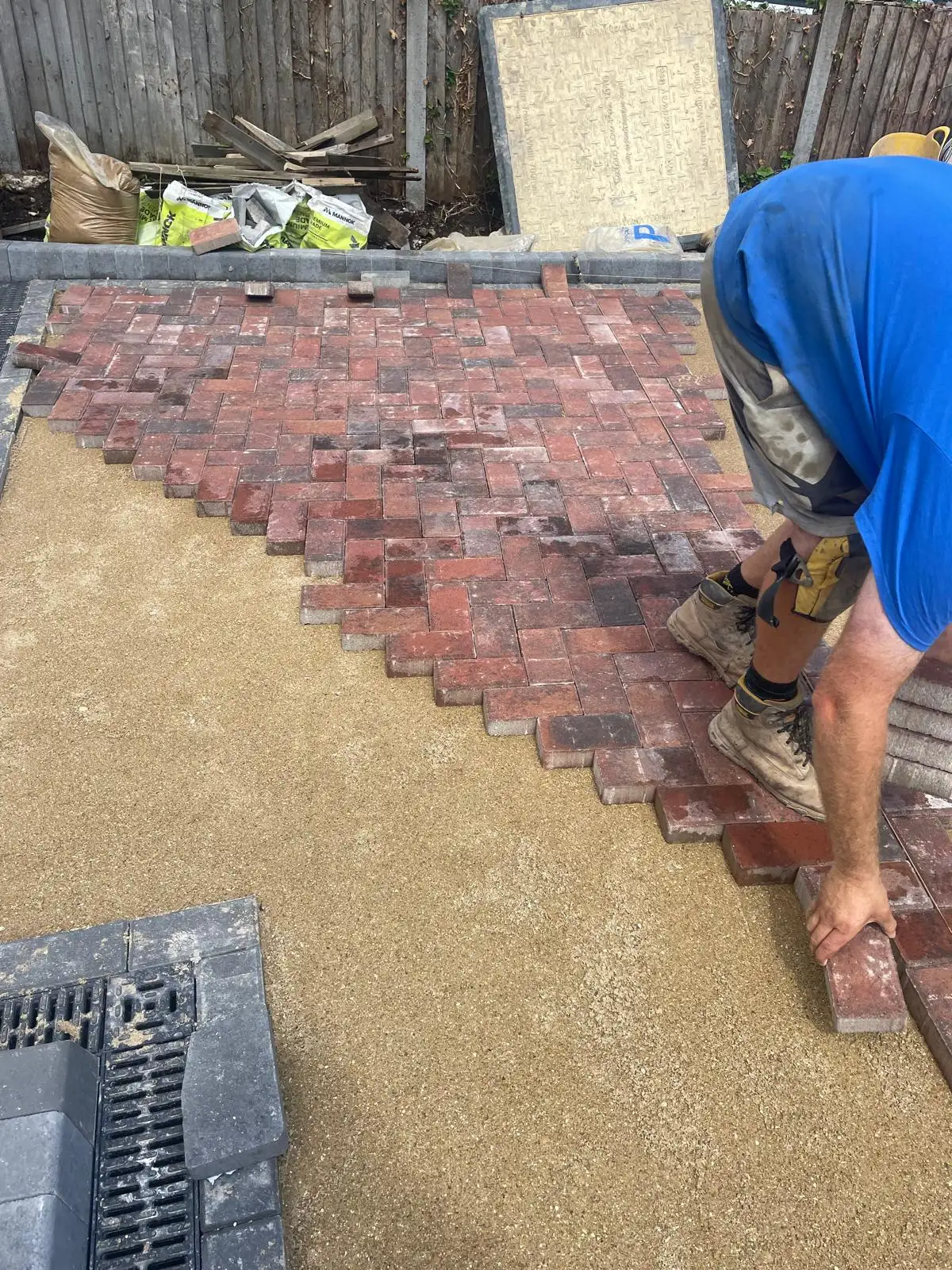
A re-lay finishes exactly like a new installation. Screeded laying course, blocks laid by hand off a string line, cuts made properly.
Your driveway, rebuilt from underneath
Everything comes up, the base is excavated and rebuilt to a proper specification, the levels and falls are corrected, and your own blocks go back down.
You get a driveway that performs like a new one without buying the surface twice. Because the blocks are typically 30 to 40 per cent of the cost of a new driveway and you already own them, a re-lay is routinely a third to a half less than starting again.
It is not a small job, and it is worth being clear about that. Everything that happens on a new installation happens here too. The difference is only that we lift and clean the existing paving at the start instead of taking delivery of new.
- Your existing blocks lifted, cleaned and reused
- The failed sub-base excavated and taken off site, not built over
- New geotextile membrane and a new sub-base compacted in layers
- Levels and falls corrected, and drainage added if it was never there
- Edge restraints rebuilt and haunched in concrete
- Cuts renewed, joints filled, and topped up again once it has settled
When re-laying makes sense, and when it does not
Re-laying is usually right when
- The blocks are structurally sound, even if they look tired
- The problem is levels, ruts, ponding or general unevenness rather than the surface material
- The driveway is settling in more than one place, which points at the base rather than a local fault
- You are happy with the colour and the pattern and do not want to change the look
- The paving is a discontinued range you could never match if you replaced part of it
A new driveway is usually the better answer when
- The blocks are 40mm rather than 50mm, so they were never a driveway block in the first place
- A large proportion are cracked, spalled or frost damaged
- You want to change the layout substantially, or go permeable
- You have never liked the colour, in which case re-laying it carefully is money spent keeping something you do not want
We will tell you which of those you are in when we look at it. It is not always the more expensive one.
What a re-lay includes
- Lifting, cleaning and stacking your existing blocks
- Excavating and removing the failed base
- New geotextile membrane
- New sub-base, compacted in layers
- Edge restraints rebuilt and haunched in concrete
- Levels and falls corrected, drainage added if needed
- Fresh laying course, screeded
- Blocks re-laid, cuts renewed, vibrated and jointed
- A return visit to top up the joints
There is a version of this sold as a quick fix, where the blocks come up, a bit of sand is raked about, and they go straight back down. It looks fine for a season and then does exactly what it did before. If a quote does not mention excavating the old sub-base and carting it away, what is being quoted is a re-screed, not a re-lay.
How simple it is to have your driveway re-laid with us
Three steps, and only the first one needs anything from you.
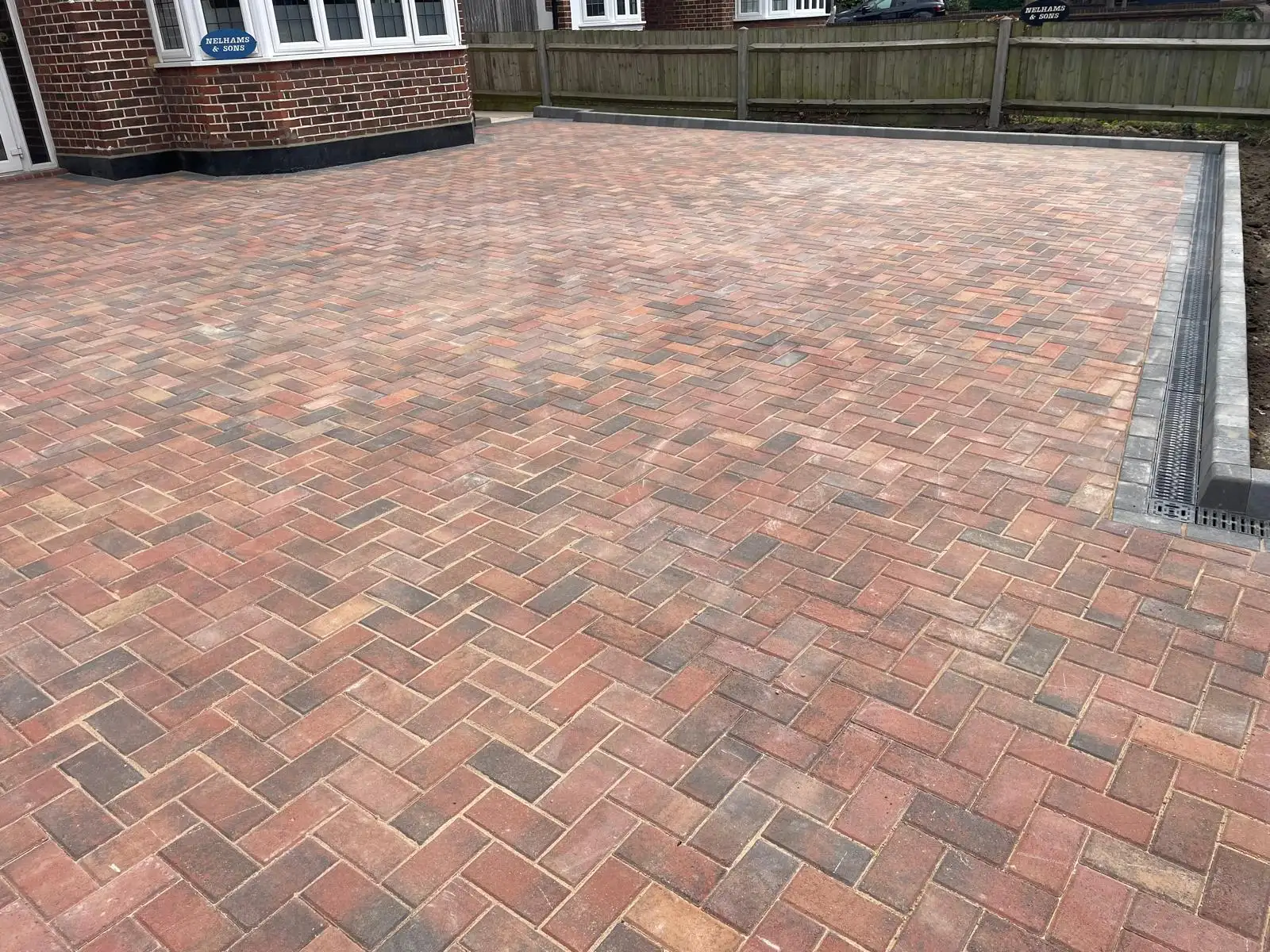
The finish after a re-lay. Same blocks, correct levels, full joints, and an edge that will hold.
Tell us about the driveway
Roughly how old it is, whether the problem is in one place or everywhere, and whether you actually like the blocks. Those three things largely decide the answer on their own. We reply within 24 hours.
We come and look, and you get a written quote
We lift a block, look at what is underneath, and assess how many of your blocks will survive being taken up. You get a written, itemised quote that separates the lifting, the groundwork and the re-laying, with a realistic figure for replacement blocks. No obligation.
We lift it, rebuild it, and re-lay it
Usually four to six working days. Your blocks are lifted, cleaned and stacked, the failed base goes off site, the new base goes in and is compacted in layers, and the paving goes back down to corrected levels. We return later to top up the joints.
Why trust us to re-lay your driveway
A re-lay is a groundwork job wearing the clothes of a cosmetic one. That is exactly why it gets done badly. Here is how we do it.
Because we rebuild the base, not the appearance
The old sub-base comes out and goes off site. If we did not do that, we would be putting your blocks back onto the same ground that failed them, which is the whole reason you called.
Because we look after your blocks
They are lifted by hand, cleaned and stacked, not shovelled into a heap. The more of them that survive, the less you spend, and that is entirely down to how carefully they come up.
Because we fix everything while it is open
Falls running the wrong way, a drive sitting too high against the damp proof course, no edge restraint, no drainage. Correcting those costs very little extra once the paving is already up, and a great deal later.
Because we are honest about the block count
We give you a realistic figure for how many blocks will not survive, before you commit, and we agree where any new ones will go so the difference reads as deliberate.
Because we will tell you when to replace instead
If your blocks are 40mm, badly spalled, or a colour you have never liked, carefully re-laying them is money spent keeping something you do not want. We say so.
Because we have been doing it since 1977
We have lifted a great many driveways that other people laid. There is not much left down there that surprises us.
Re-laying questions
Is re-laying really cheaper than a new driveway?
Usually yes, and the saving is meaningful, because the blocks are typically 30 to 40 per cent of the cost of a new driveway and you already own them. You are paying for labour, for the sub-base materials, and for taking the old base away.
It is not a small job though. Everything comes up, so the groundwork is the same as a new drive. Anyone quoting a re-lay as a quick tidy-up has not planned to rebuild the base, which is the only reason to do it.
How many of my blocks will survive?
On a driveway of reasonable age, typically most of them. Concrete blocks are tough and the failure is almost always in the base rather than the block. Losses come from cracked blocks over voids, frost-damaged faces, and the cuts, which rarely survive being lifted.
We work out a realistic figure when we look at it, and we plan for cuts to be replaced. If a proportion of the field has to be made up, we discuss where the new blocks go before we start, because putting them in one area looks intentional and scattering them does not.
Will it look different afterwards?
Cleaner, mostly. Blocks that have been lifted, cleaned and re-laid with fresh jointing look markedly better than they did, because a lot of what reads as a tired driveway is silt in the joints and a surface that has gone uneven.
The one thing to expect is that the colour of the reused blocks is the weathered colour, not the original. If new blocks go in alongside them, they will be brighter for a year or two before they settle in.
Can you change the levels while you are at it?
Yes, and this is often the real reason to do it. Since the whole surface is coming up, correcting a fall that runs towards the house, lifting a drive that sits too high against the damp proof course, or introducing a proper crossfall to a channel drain costs very little extra at that point.
The same applies to adding drainage, changing the layout, or putting in an edge restraint that was never there. If you are lifting it anyway, fix everything at once.
Can I have it re-laid as a permeable driveway?
Only with new blocks. Standard blocks have flat sides and are laid on sand with sand joints, whereas permeable blocks have spacer nibs that create a wider joint filled with grit. You cannot convert one to the other.
You can, however, rebuild the base as a permeable one, or keep the blocks and deal with the water using a channel drain into a soakaway. We talk through which of those makes sense on the permeable paving page.
How long does a full re-lay take?
Usually four to six working days for a typical driveway, because everything that happens on a new installation happens here too, plus the lifting and cleaning of the existing blocks at the start.
You will not be able to park on it during that time. We give you the dates up front and stick to them unless the ground turns out to be worse than the trial hole suggested, in which case you hear about it that day.
We’ll tell you which job it actually is
Tell us about your driveway and your plans. We’ll get back to you within 24 hours.
Mention roughly how old the driveway is, whether the problem is in one place or everywhere, and whether you like the blocks.
Those three things decide most of it, and we can usually give you a steer before we visit.
- We come out and look at it properly
- Written, itemised quote
- No obligation and no chasing afterwards