Driveway extensions and widening
Room for the second car, with new paving matched as closely as it honestly can be to what is already down.
- Laying driveways since 1977
- Over 45 years’ experience
- Which? Trusted Trader
- Fully insured
- 30+ 5-star reviews
Is your driveway simply not big enough any more?
The household went from one car to two, and the second one now lives on the road. In most of Twickenham, that means it lives on the road some distance away.
You already know the routine. Somebody circles the block at seven in the evening. Whoever is parked in first is blocked in until morning. There is a permanent low-level negotiation about who needs to leave earliest, and a shuffle in the rain most mornings to let the other car out.
The frustrating part is that the space usually exists. It is currently lawn, or a border, or a strip down the side of the house that nobody has ever done anything with. What is not obvious is whether it can be made into parking that genuinely works, or whether you end up with a space a car can technically get onto but nobody ever uses.
It tends to be one of these four:
- Only one car fits. The frontage is wide enough on paper, but not once you can open the doors on both sides.
- They fit, but only nose to tail. Which means one car is always trapped, and somebody is moving it before breakfast.
- There is space, but it is grass. Half the frontage is doing nothing useful and the second car is on the street.
- The car overhangs the pavement. Not just inconvenient. Richmond upon Thames requires a vehicle to park fully within the property.
Whether the answer is a widening or something else comes down to four measurements, and you can take them yourself in ten minutes.
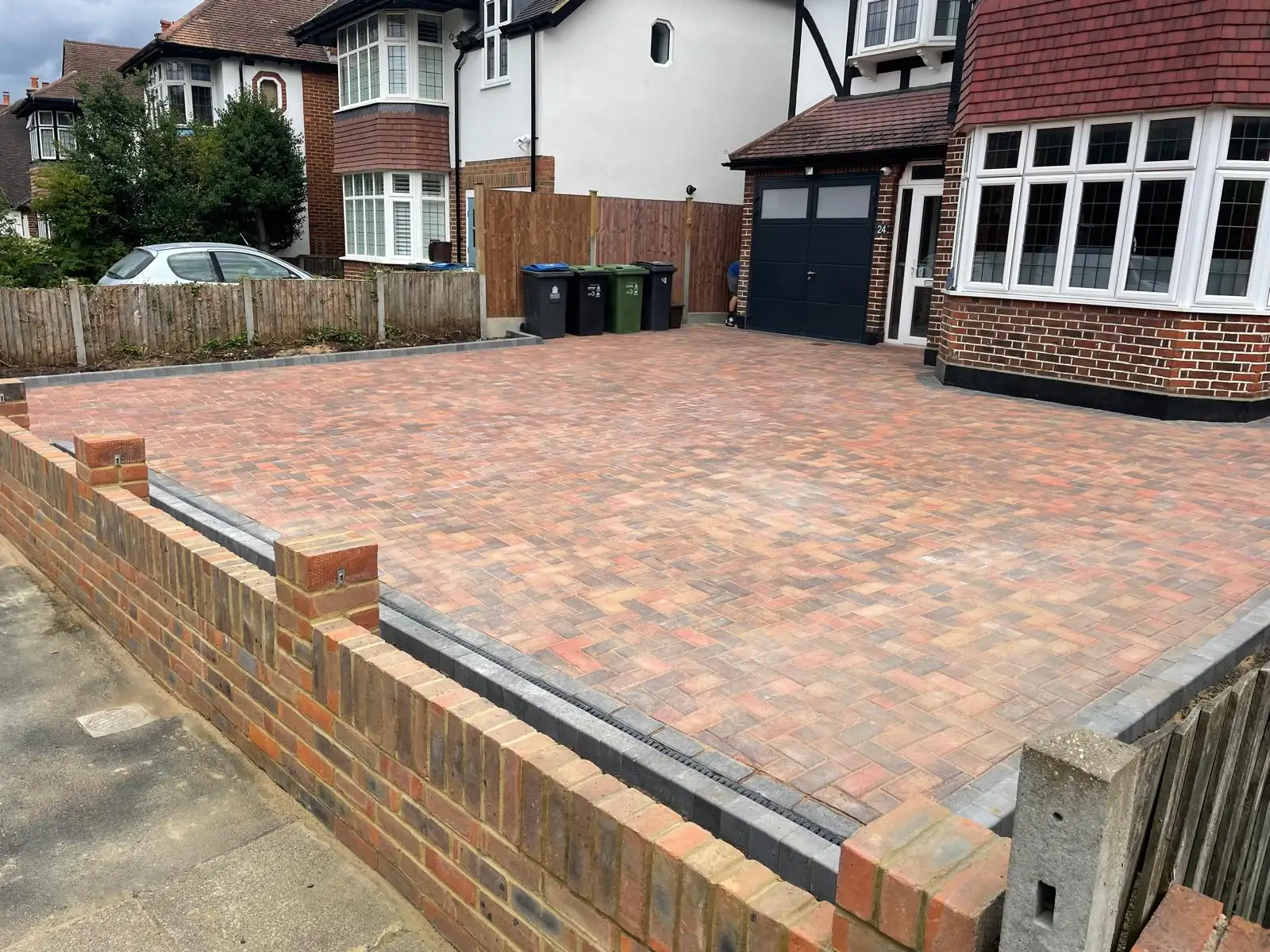
A frontage taken to full width with genuine parking for two, the boundary wall rebuilt to suit and the water taken along a channel rather than over the footway.
Two cars, and no more shuffling
We extend the driveway into the space you already have, with the new section built on its own proper sub-base and joined so it reads as one driveway rather than two.
The whole job is judged on one line: where the new paving meets the old. Get that right and nobody can tell it was ever extended. Get it wrong and it looks like an extension bolted on, however good the new section is on its own.
So we do not butt fresh paving up against an old drive and hope. The new area gets its own excavation and its own compacted sub-base to the same depth as everything around it, the old edge restraint gets rebuilt at the new perimeter rather than left buried in the middle, and the falls get re-thought because a wider driveway sheds more water than the original drainage was ever sized for.
- Enough usable width that both doors actually open
- New section on its own full-depth, properly compacted sub-base
- The old edge restraint rebuilt at the new perimeter, not buried
- Paving matched where we honestly can, and designed where we cannot
- Falls and drainage re-thought for the larger area
- Front wall opened up and the ends rebuilt into proper piers if needed
The four measurements that decide it
Take these yourself with a tape before you speak to anybody, ourselves included. They will tell you most of what you need to know.
| Measurement | Comfortable | Tight but workable | Why it matters |
|---|---|---|---|
| Depth footway to house | 5.0m+ | 4.8m | Below this the car overhangs the footway, which the council will not accept with a crossover |
| Width for two cars side by side | 4.8m+ | 4.5m | Below this you cannot open both driver’s doors properly |
| Width single car with door access | 3.0m | 2.6m | A 2.4m strip parks a car but you get out onto the border |
| Side access down the flank of the house | 2.7m+ | 2.5m | Wing mirrors, guttering and the neighbour’s fence all take their share |
If the numbers do not work, we will say so. Extending a driveway into a space that will not comfortably hold a car is the one job we would rather talk you out of.
The join is the whole job
Matching the base, not just the surface
The new area gets a full excavation and a properly compacted sub-base of its own. This is not optional and it is where the cost sits. If the new section settles even 10mm more than the old one, you will feel the ridge every time you drive over it and see it every time it rains.
Dealing with the old edge restraint
Whatever was holding the original driveway in is now in the middle of the new one. Either it comes out and gets rebuilt at the new perimeter, or we keep it deliberately as a contrasting course so the transition looks intended. Leaving it buried and hoping is how you get a crack along that line.
Being honest about colour
Your existing blocks have been weathering for years. New blocks of the identical product will not match them on day one, and there is no treatment that fixes that. They converge over a couple of years. Where we cannot get the product at all, we design the difference in rather than trying to disguise it.
Re-thinking the falls
A wider driveway sheds more water. If the original fall took everything to one corner, doubling the area may overwhelm it. This is usually the moment to add a channel drain and take the water somewhere sensible, particularly given it must not run out onto the highway. See permeable paving and drainage.
Also worth knowing
Widening the drive does not widen the crossover. If the extra parking sits behind full-height kerb, you cannot legally drive across the footway to reach it. Widening a dropped kerb is a separate application to Richmond upon Thames with its own charges.
Watch the soft landscaping. If your crossover was granted on the basis of keeping at least ten per cent of the front garden planted, paving over the rest of it later is not a neutral act.
Street trees are not negotiable. If widening means working near a council tree, the tree officer is involved, and root protection changes the build-up.
How simple it is to get more parking with us
Three steps, and the first one is a tape measure.
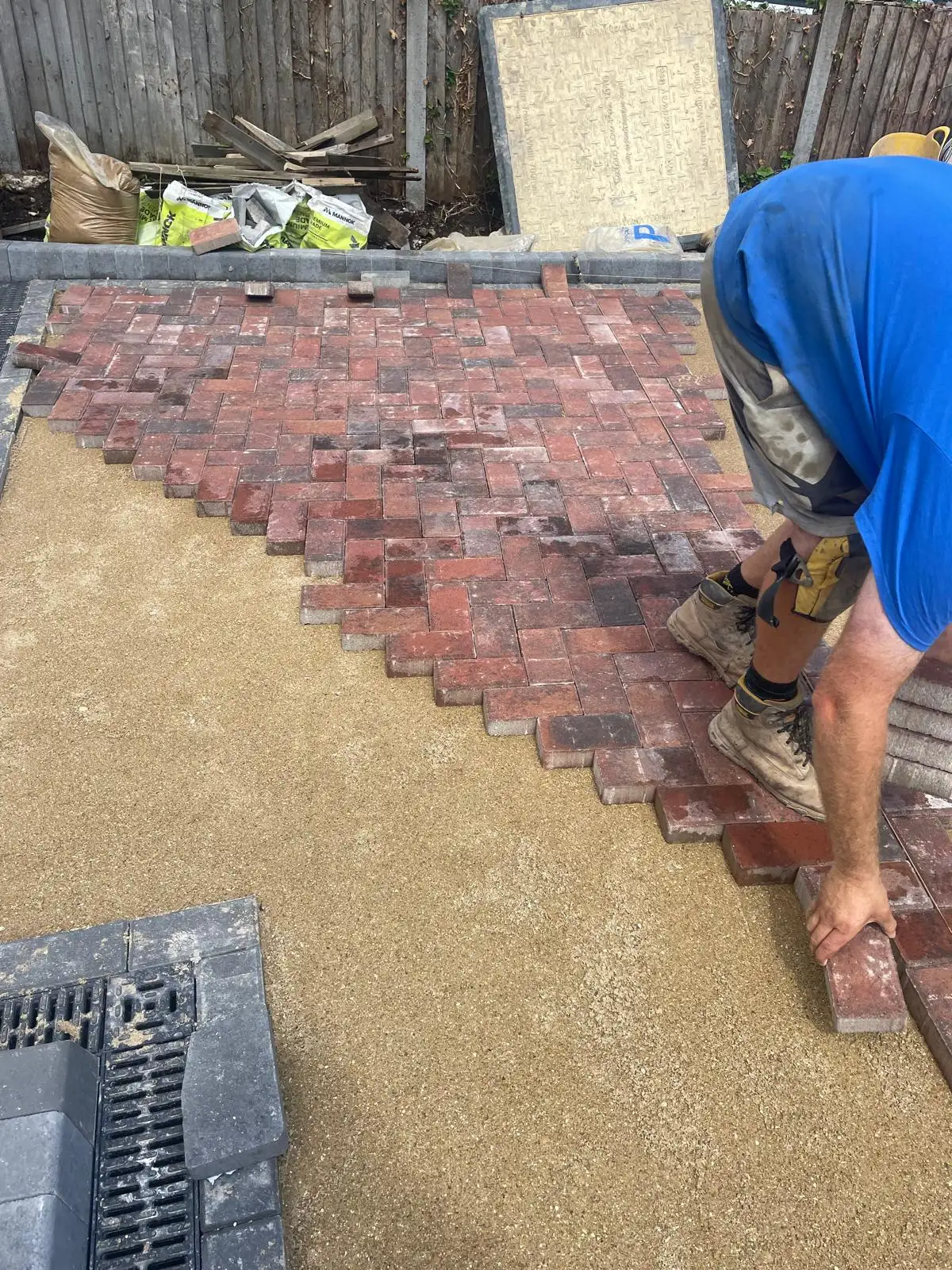
Step three. The new section built to the same specification as everything around it, so the join does not show in two years’ time.
Send us your measurements
Depth from the back of the footway, the width available, and what is currently paved. From those three numbers we can usually tell you straight away whether a second car will genuinely fit, before anybody visits. We reply within 24 hours.
We come and look, and you get a written quote
We check the levels, look at the existing paving and its edge restraint, work out where the water will go once the area is larger, and open a trial hole in the ground you want to build on. You then get a written, itemised quote separating the new paving, the groundwork and any brickwork.
We build it, and clear up properly
An extension is usually two to four working days depending on size and on whether a wall is being altered. Everything goes off site, and we come back a few weeks later to top up the joints once the new paving has settled.
Why trust us to extend your driveway
Extensions are where corners get cut, because the new area is small and the temptation is to build it lightly and butt it against what is there. Here is why ours do not show.
Because we build the new part like a new driveway
Full excavation, geotextile membrane, sub-base compacted in layers to the same depth as the original. A shallow extension settles at a different rate to the drive beside it, and then the join is visible forever.
Because we will tell you if it will not fit
We would rather lose the job than build you a parking space nobody can get out of. If the numbers do not work, you will hear that at the quote stage, for free.
Because we are honest about matching
Where an exact match is not possible we say so, and design the difference in deliberately rather than chasing an almost-match that will read as a mistake for the next twenty years.
Because we know what the council will allow
Widening the drive does not widen your crossover, and paving over the last of the front garden can breach the condition your crossover was granted under. We raise both before you commit, not afterwards.
Because we re-think the drainage
A bigger driveway sheds more water, and it still must not run onto the highway. We resize the falls and add drainage where the original arrangement can no longer cope.
Because we have been doing this since 1977
Long enough to know exactly which frontages in this part of London will take a second car and which ones will not.
Extension and widening questions
How wide does a driveway need to be for two cars?
Around 4.8 to 5 metres of usable width is the comfortable figure for two cars side by side, and that is width you can actually park on, not the distance between the boundaries. Below about 4.5 metres you can physically fit two cars but somebody is climbing across a seat.
Depth matters just as much. Around 5 metres from the back of the footway lets a normal car sit fully on the drive, which the council requires if you have a crossover. Many Twickenham frontages are shallower than that, and it is better to find out before you spend money.
Will the new paving match the old?
Sometimes, and we will tell you honestly which. If the block is a current range we can often get an exact product match, though it will be brighter than yours for a year or two until it weathers in.
If the range is discontinued, chasing a near match is usually a mistake, because almost-right reads as a mismatch while clearly-different reads as a design. The better answers are to run a contrasting border between old and new, or to use the new blocks in a distinct area such as a bay or an apron. We will show you the options at quote stage.
Can you just add to the edge of what is there?
Physically yes, but not straight onto it. The existing driveway has an edge restraint holding it in, and that restraint is now in the middle of your new driveway. It either has to be removed and rebuilt at the new perimeter, or deliberately retained as a feature course.
The bigger issue is that the new section needs its own properly excavated and compacted sub-base. Butting fresh paving against an old drive without matching the base underneath is exactly how you get a ridge along the join within a couple of years.
Do I need permission to widen my driveway?
For the paving itself, the same rules apply as for a new driveway: permeable, or drained inside your boundary, and you are normally within permitted development. Conservation areas and Article 4 directions change that.
The part people miss is the crossover. Widening the driveway does not widen the dropped kerb, and if the extra parking space sits behind full-height kerb you cannot legally drive over it. Widening a crossover is a separate application to the council.
Can you take out part of the front wall?
Yes, and it is often part of the same job. Removing a section of low wall, rebuilding the ends into proper piers and re-capping so it looks original rather than truncated is standard work for us. See edging, kerbs and boundary walls.
In a conservation area the front boundary wall is frequently the element the council cares about most, sometimes more than the paving, so check before assuming it can come out.
Is it cheaper than laying a whole new driveway?
Per square metre, no. A small extension carries the same fixed costs as a large driveway — mobilisation, excavation plant, disposal, edge restraints — spread across fewer metres, so the rate looks higher.
In total, of course, yes, because you are paying for a fraction of the area. What is worth weighing is that if the existing driveway is also tired, doing both at once is usually better value than extending now and replacing in three years.
Send us your measurements
Tell us about your driveway and your plans. We’ll get back to you within 24 hours.
Depth from the footway, the width available, and what is currently paved.
From that we can usually tell you whether the second car will genuinely fit before we have even visited.
- We come out and look at it properly
- Written, itemised quote
- No obligation and no chasing afterwards