Permeable block paving and driveway drainage
Driveways built so rainwater soaks away inside your boundary instead of running into the road, which is what Richmond upon Thames expects when you apply for a crossover.
- Laying driveways since 1977
- Over 45 years’ experience
- Which? Trusted Trader
- Fully insured
- 30+ 5-star reviews
Told your driveway has to be permeable, and not sure what that means?
It is the condition that surprises people. You set out to buy a driveway and find you have to understand drainage engineering first.
If you are applying for a new dropped kerb in Richmond upon Thames, the council expects the hard standing to be built in permeable materials, at least a tenth of the front garden to stay planted, and no water at all to discharge onto the highway or into the public sewer. Those are conditions, not suggestions, and they shape the driveway before you have chosen a single block.
Or you may have arrived here the other way round: water already pools by your front door, runs across the pavement and freezes there in winter, and somebody has told you it should not be doing that. They are right, and it is fixable.
The usual reasons people end up on this page:
- The crossover application says permeable. And you would rather understand it now than after the driveway is built.
- Water runs off your drive onto the pavement. Which is not permitted, and becomes your problem the first time it ices over.
- You want to avoid a planning application. A permeable surface keeps you within permitted development whatever the size.
- The frontage floods. Standing water at the threshold after every downpour, and nowhere for it to go.
All of it comes down to the same principle: your rainwater has to stay on your land.
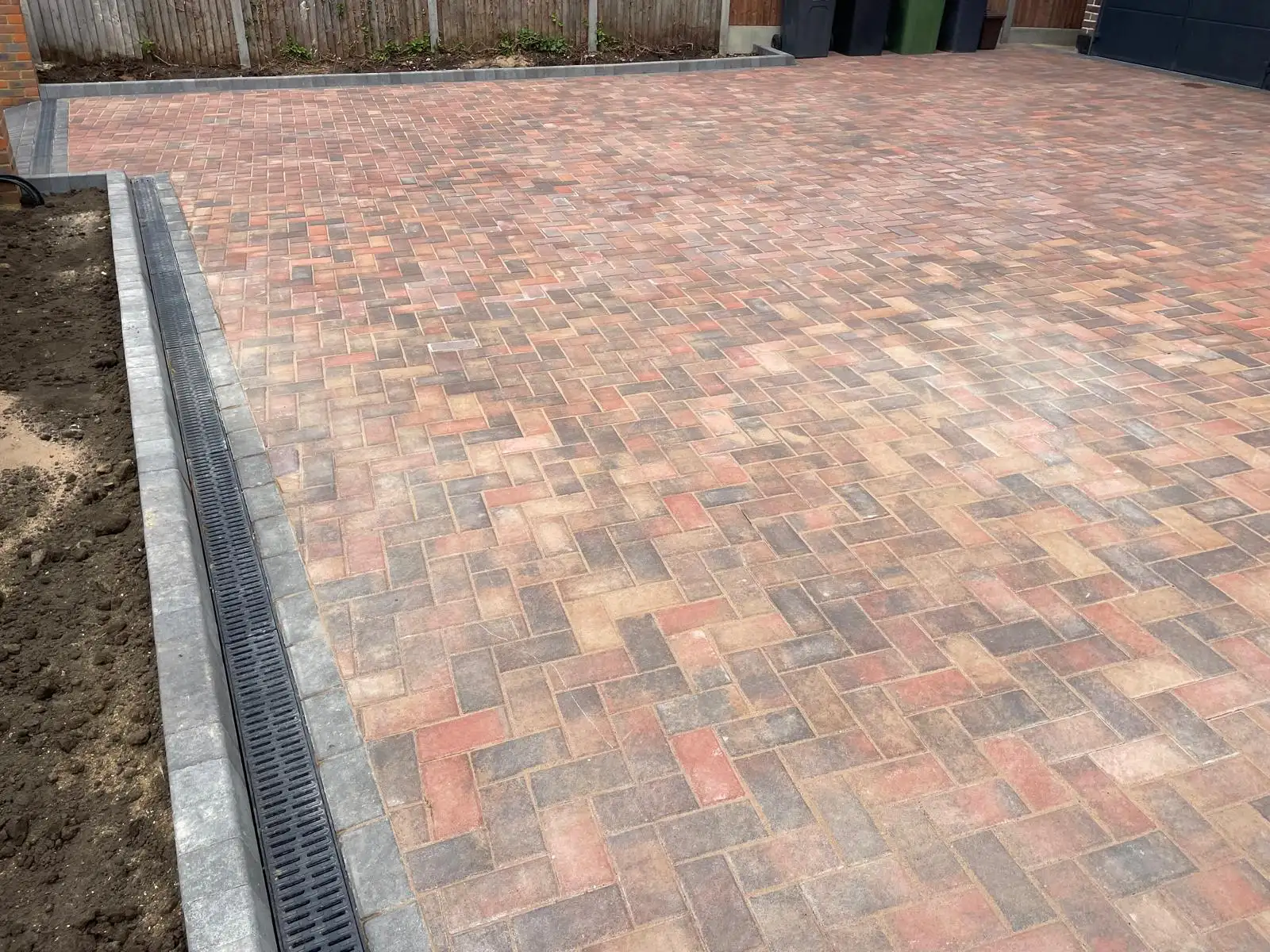
Where a fully permeable build is not the right answer, a channel drain across the threshold discharging to a soakaway inside the boundary achieves the same end: the water stays on your land.
A driveway that drains itself
We build the surface and the drainage as one thing, so rainwater goes straight through the joints into a stone reservoir underneath instead of running off to somewhere it should not be.
From the pavement it looks like an ordinary block paved driveway. The difference is entirely in the build. Rather than shedding water off the surface to a gully, a permeable driveway lets it through the joints into an open-graded stone layer, where it either soaks into the ground or is released slowly.
That means the sub-base is doing two jobs at once — carrying the car and storing the rain — so how deep it needs to be depends on your ground and on how much water the area has to hold. It is the reason a trial hole matters here more than anywhere else.
- Meets the borough’s permeable surfacing condition for a new crossover
- No planning application needed on surfacing grounds, whatever the size
- Open-graded sub-base sized as a reservoir for your ground and area
- Permeable geotextile so fines cannot migrate up and clog it
- 2–6mm clean grit laying course and jointing, never sand
- Soft landscaping designed in rather than left as an awkward strip
What is different underneath
People assume permeable blocks are porous. They are not. Water goes through the joints, not the block. Permeable blocks are moulded with small spacer nibs that hold a wider joint, and that joint is filled with clean angular grit rather than sand.
Which changes the whole build-up:
- Jointing: 2–6mm clean grit. Never kiln-dried sand, which would seal the very thing that makes it work.
- Laying course: the same clean 2–6mm grit, screeded flat, rather than sharp sand.
- Sub-base: an open-graded, no-fines stone that holds water in its voids. Conventional MOT Type 1 is deliberately well-graded so it locks up tight, which is exactly what you do not want here.
- Depth: set by how much rain the area has to hold and how fast the ground below will take it. On good ground that might be around 200mm. On poor ground it can be two or three times that, because the stone is doing the storing.
- Membrane: a permeable geotextile between subgrade and sub-base, to keep fines from migrating up and clogging the reservoir.
That last point is why a permeable driveway is not simply a normal driveway with different blocks. Get the sub-base wrong and you have paid extra for permeable blocks sitting on something water cannot get through.
What Richmond upon Thames asks for
- Permeable hard standing — permeable blocks, gravel or porous asphalt
- At least 10% soft landscaping retained on the frontage
- No discharge to the highway or public sewer — water dealt with inside your boundary
- The car parked fully on the property, with no overhang across the footway
- At least one metre of footway kept clear for pedestrians
On a steeply falling frontage, water can run across the surface faster than it infiltrates, so you need conventional drainage anyway and pay for the permeable build on top. On heavy clay with no viable outfall, a tanked reservoir can be more engineering than the job warrants. In both cases a conventional drive with a channel drain to a soakaway is the better answer, and we will say so.
How simple it is to get a permeable driveway with us
Three steps, and the trial hole in step two decides most of the specification.
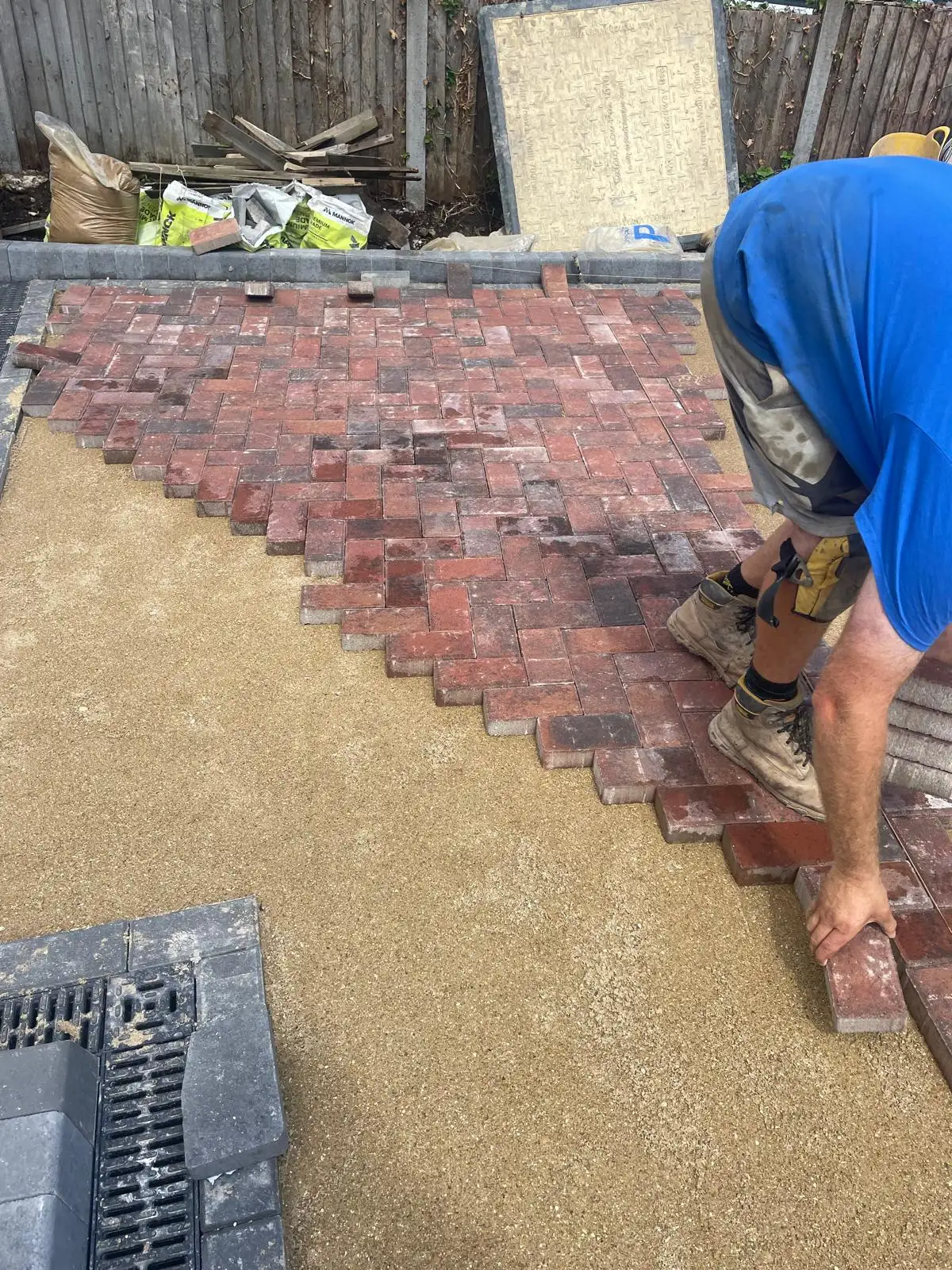
Step three. The channel drain set to its finished level before any block is laid, because drainage goes in first, not last.
Tell us where you are in the process
Whether you have applied for a crossover yet, whether you already have a dropped kerb, and roughly how big the frontage is. If you are at the application stage, say so — the sequencing matters and we can save you a wasted application. We reply within 24 hours.
We come and look, and open a trial hole
Gravel or clay changes everything here, because it decides whether the water can soak away or whether the sub-base has to store it. We check levels and outfall options at the same time, then give you a written, itemised quote with the build-up stated.
We build it, drainage first
Excavation, permeable membrane, open-graded sub-base compacted in layers, edge restraints and any channel or soakaway, then the grit laying course and the blocks. Typically four to six working days. We come back later to check the joints.
Why trust us with a permeable driveway
Permeable paving is the easiest kind of driveway to get subtly wrong, because everything that matters is invisible once it is finished.
Because we build the sub-base to match your ground
Gravel and clay need completely different designs. We open a trial hole before quoting, so the reservoir depth we price is the depth your ground actually requires rather than a number copied off a spec sheet.
Because we use the right stone, not Type 1
Conventional MOT Type 1 is well-graded so it locks up tight and sheds water. Under permeable blocks it defeats the entire purpose. We use an open-graded, no-fines stone, and we will show you the delivery ticket if you would like to see it.
Because we never put sand in the joints
Permeable joints take 2–6mm clean grit. Sand seals them. It sounds obvious and it is one of the most common ways a permeable driveway is ruined, sometimes by a well-meaning contractor a few years later.
Because we know the borough’s conditions
Permeable surfacing, ten per cent soft landscaping, nothing discharging to the highway, the car fully on the property. We design to all four from the first sketch rather than discovering them at inspection.
Because we will tell you when permeable is wrong
On some frontages a conventional drive with a properly designed channel drain and soakaway is the better and cheaper answer, and satisfies the same requirement. We would rather say that than sell you a bigger build.
Because we have been doing it since 1977
Long before SuDS had an acronym, we were working out where water was going to go on Twickenham frontages. The rules changed. The problem did not.
Permeable paving questions
Does a permeable driveway cost more?
Yes, typically somewhere between ten and twenty-five per cent more than a standard build of the same size. The extra is in the sub-base, which is deeper and uses a cleaner, more expensive open-graded stone, and in the blocks themselves.
What it saves you is a planning application, and sometimes a soakaway. On a frontage where a conventional drive would have needed an attenuation system anyway, permeable often works out level or cheaper.
Does it still work on clay?
It works differently. On free-draining gravel the water passes through the sub-base and away into the ground. On London Clay it cannot, so the sub-base has to be sized as a reservoir that holds the rainfall and releases it slowly, either into the ground at whatever rate the clay will take, or through a controlled outlet.
That means a deeper stone layer and sometimes a tanked design with a restricted outfall. It is entirely normal and we build them regularly. It does mean the trial hole at survey stage matters, because clay and gravel give completely different answers.
Will the joints clog up over time?
They silt gradually, yes, and the permeability reduces over the years. It does not stop working, but it slows down.
The maintenance is straightforward: keep leaves and soil off it, and every few years have the top of the joints vacuumed out and re-filled with fresh grit. Never fill the joints with kiln-dried sand or brush soil into them, which is the usual way a permeable driveway gets ruined by accident.
Do I have to have permeable paving?
Not always. Nationally, a driveway over five square metres needs planning permission only if it is impermeable and the water runs off onto the highway. Drain it to a lawn, a border or a soakaway within your own boundary and you stay within permitted development.
Where it becomes effectively compulsory is when you apply for a new dropped kerb in Richmond upon Thames, because the borough asks for the hard standing to be built in permeable materials as a condition. See our dropped kerbs guide.
Can you make my existing driveway permeable?
Not by treating the surface. Permeable paving is a build, not a coating, and it goes all the way down.
What we can often do instead is deal with the water without rebuilding: a channel drain across the threshold taking runoff to a soakaway inside your boundary, or re-grading the falls so the drive discharges onto a border rather than into the road. That satisfies the same underlying requirement, which is that your rainwater stays on your land.
Does it look different from a normal block paved driveway?
Barely. From the pavement it reads as an ordinary block paved drive. Up close the joints are slightly wider and filled with a fine grit rather than sand, and the blocks have small spacer nibs on their sides.
The colour ranges and the laying patterns are much the same as conventional block paving, so you are not sacrificing the look to get the drainage.
Tell us about your frontage
Tell us about your driveway and your plans. We’ll get back to you within 24 hours.
If you are at the crossover application stage, say so. The sequencing matters and we can save you a wasted application.
It also helps to know whether water currently runs off your frontage onto the pavement.
- We come out and look at it properly
- Written, itemised quote
- No obligation and no chasing afterwards