Block paving repairs in Twickenham
Sunken patches, rutted bays, broken blocks and failed edges put right, usually without touching the rest of the driveway.
- Laying driveways since 1977
- Over 45 years’ experience
- Which? Trusted Trader
- Fully insured
- 30+ 5-star reviews
Is your block paving uneven, unsightly, or starting to be a hazard?
A block paved driveway rarely fails all at once. It goes gradually, and one day you notice you have been stepping around the same dip for two years.
The blocks have sunk where the wheels sit. There is a lip at the threshold that catches the bin every week and has already caught somebody’s toe. Water gathers in the same spot after every shower and freezes there in January. The joints are green, the edges have crept outwards, and the frontage has gone from smart to shabby without any single moment where it obviously broke.
The frustrating part is not knowing how serious it is. Is that dip cosmetic, or is the ground underneath giving way? Does it need patching, or does the whole drive need lifting? Nobody wants to spend thousands finding out.
It usually shows up as some combination of these:
- Uneven and rutted. Two troughs where the wheels go, a dip by the garage, a surface that no longer looks flat from the pavement.
- Genuinely unsafe. A raised lip at the threshold, blocks that rock underfoot, ice sitting where the water ponds. This is the one worth acting on quickly.
- Unsightly. Weeds and moss through the joints, faded and patchy colour, oil marks, edges that have wandered out of line.
- Spreading. It started as one small area and there are now two or three. Water is getting into the base and taking the problem with it.
Almost none of that needs a new driveway.
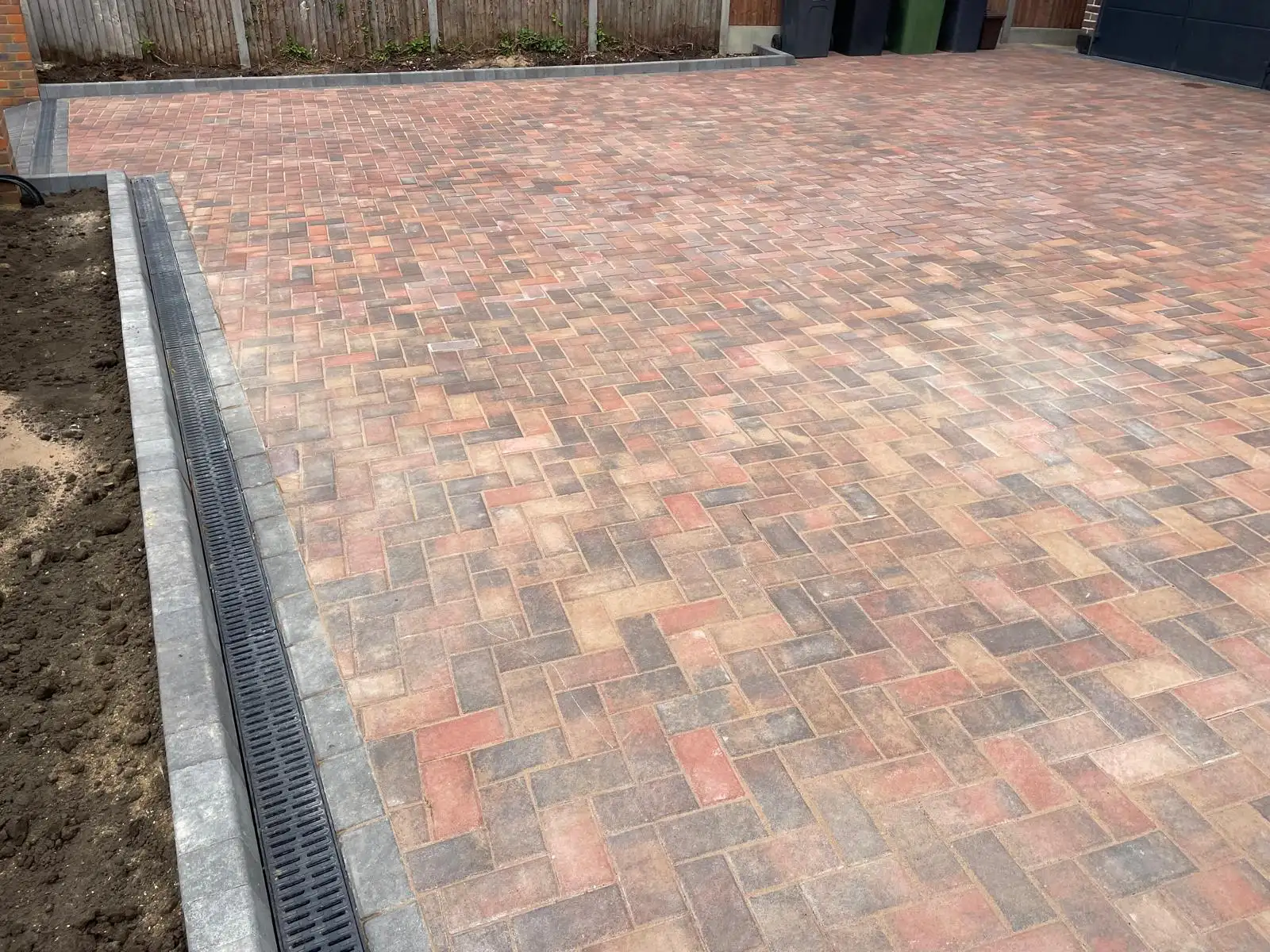
What a repaired edge should look like afterwards: straight, restrained, draining properly, and indistinguishable from the rest of the drive.
Put right, not patched over
We lift the affected blocks, find out why it failed, rebuild the base underneath properly, and put your own blocks back down.
Block paving is the one driveway surface designed to be taken apart. A cracked concrete drive has to be broken out. A patched tarmac drive looks patched forever. Block paving comes up in your hands, goes back down, and afterwards you cannot see where the repair was.
Which is why the sensible first question about a failing block paved driveway is almost never “how much to replace it”. It is “what is going on underneath, and how much of it has to come up”. Quite often the answer is less than you feared. We are regularly called out to quote for a new driveway and end up quoting for a two-day repair instead.
- Your existing blocks reused, so the repair matches by definition
- The cause found and fixed, not just the symptom levelled out
- Sub-base rebuilt to a proper depth and compacted in layers
- Levels and falls corrected so water stops gathering there
- Edge restraints rebuilt and haunched where they have failed
- Joints refilled, and topped up again once it has settled
Where it fails tells you why it failed
Block paving goes wrong in a small number of recognisable ways, and each one points at a different cause and a different fix.
A dip exactly where the wheels sit
Two parallel troughs down the drive mean the sub-base was too thin or under-compacted for the load. The blocks are fine. They come up, the base gets rebuilt to a proper depth and compaction, and they go back down.
A dip around a manhole or in one small patch
Usually a service trench that was backfilled loosely years ago, or ground disturbed when a drain or a water main was worked on. A genuinely local problem and a genuinely local fix. The cheapest kind of repair there is.
The edges have crept outwards
Widening joints along the perimeter, blocks tipping at the boundary, or a soldier course that has rotated. The edge restraint has failed or was never haunched in concrete. Until that is rebuilt, anything done to the middle will slowly undo itself.
Settlement along the front, at the kerb
Very common on driveways built up to a crossover. It is where the heaviest, most repeated load lands, and where compaction is hardest to achieve. It normally needs the front metre or two rebuilding properly rather than packing up.
Broken and spalling blocks
Individual cracked blocks usually mean a void underneath rather than a bad block. Replacing the block without dealing with the void just breaks the next one. Faces flaking off in winter is frost damage, and those blocks do need swapping.
Weeds, moss and open joints
The jointing sand has washed out. On its own it is maintenance. But once enough sand has gone, the blocks stop bracing each other and the surface begins to move, so it is worth putting right before it becomes structural.
How simple it is to get your driveway put right
Three steps, and only the first one needs anything from you.
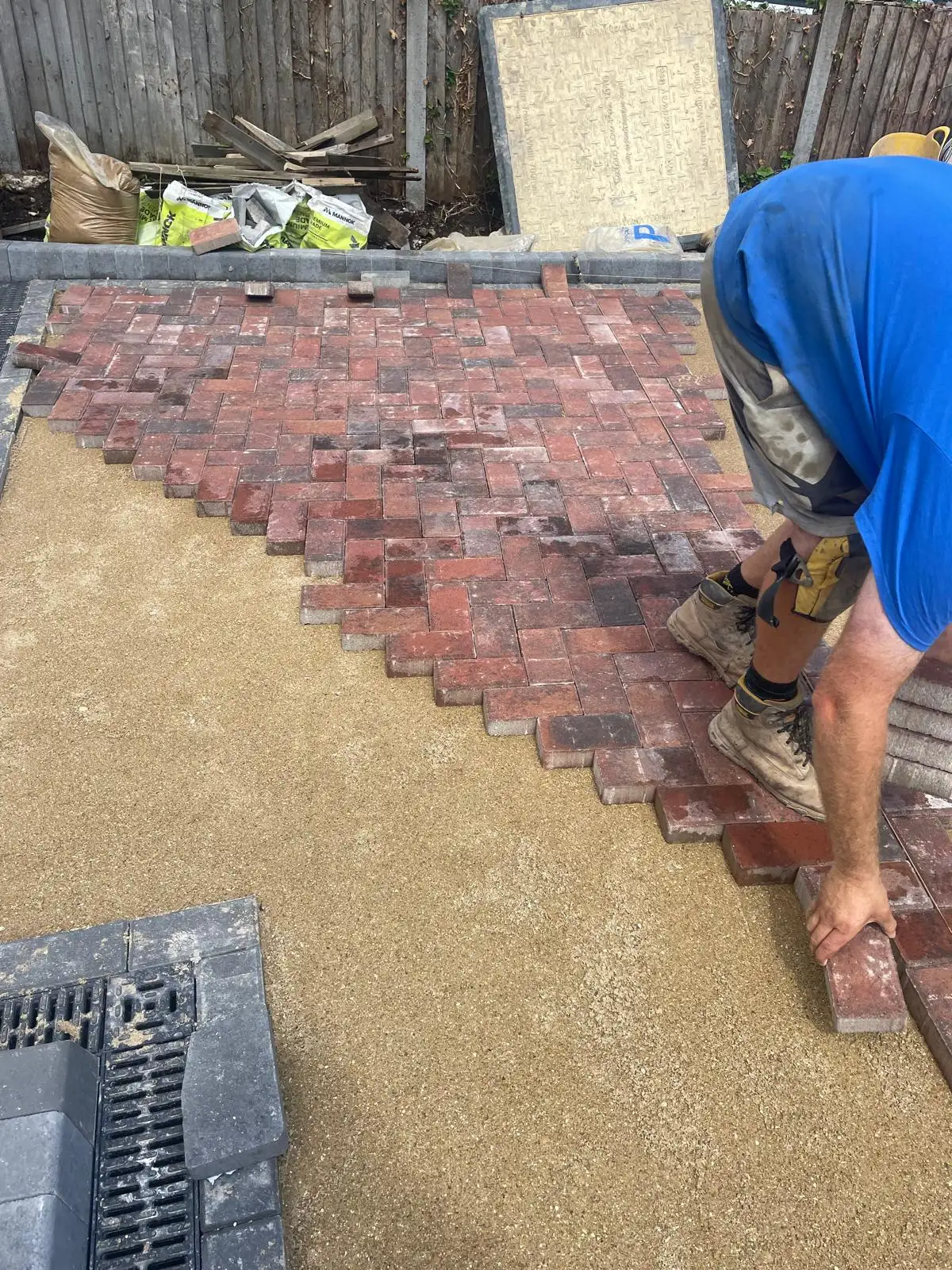
Step three. A repair finishes exactly like a new installation: screeded laying course, blocks laid by hand, cuts made properly.
Tell us what it is doing
Describe where the problem is, roughly how big the affected area is, and how long it has been getting worse. That alone is usually enough for us to say whether it sounds like a repair, a re-lay, or a bag of jointing sand. We reply within 24 hours.
We come and look, and you get a written quote
We lift a block at the edge of the failed area and look at what is under it. That takes minutes and it settles the question, because what is under there decides everything. You then get a written, itemised quote with no obligation attached to it.
We put it right, and clear up
Most repairs are a day or two. Everything goes off site, the drive is washed down and re-jointed, and we come back a few weeks later to top up the joints once it has settled and had some rain on it.
Why trust us to repair your driveway
A repair is easy to do badly. Level the dip, drop the blocks back in, take the money, and it fails again in two winters. Here is why ours hold.
Because we find out why it failed
Thin sub-base, no compaction, a loose service trench, a silted soakaway, a leaking gully. There is always a reason. Repairing without finding it is guesswork, and guesswork is why so many repairs need repairing.
Because we repair back to sound ground
The failed area is always larger than the visible dip. We lift back until we reach ground that is genuinely sound rather than stopping at the edge of the hollow. That is the single most common reason a repair fails a second time.
Because we will tell you when patching is a waste of money
If the whole drive sits on the same inadequate base, patching it is money down the drain. We will say so, and price lifting and re-laying the lot so you can compare the two properly rather than find out in eighteen months.
Because we will tell you when you do not need us
If the joints are simply empty and nothing is moving, a bag of kiln-dried sand and half an hour will genuinely sort it. We say that fairly often. It costs us a job and saves you a few hundred pounds.
Because we have seen a great many of these
We have been laying block paving since 1977, and a good share of our work is going back to look at other people’s. After enough of them you stop guessing about what causes what.
Because block paving is all we do
Not resin, not tarmac, not landscaping with driveways on the side. One trade, done properly, by the people who quoted it.
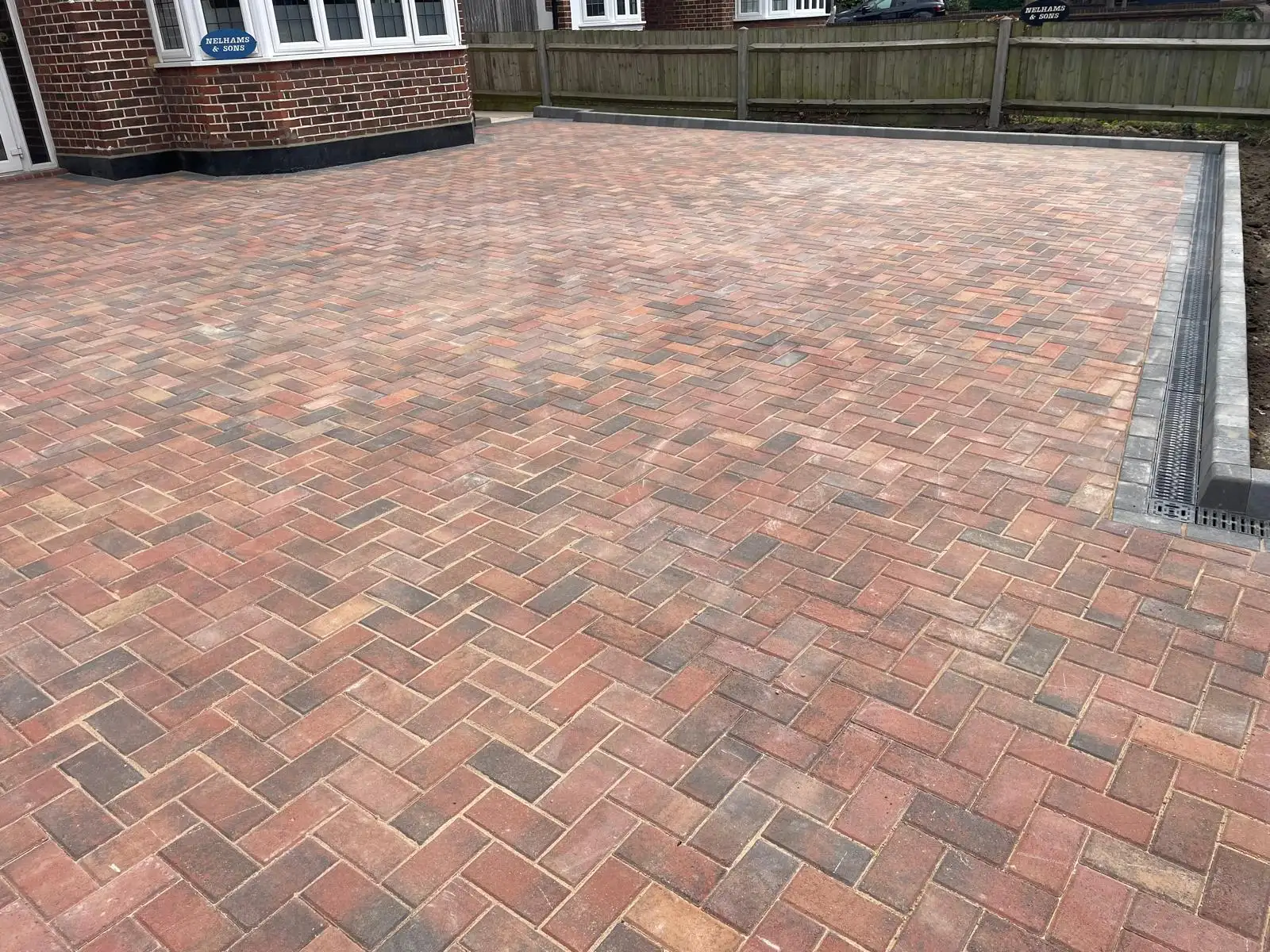
Full, consistent joints. Most long-term block paving failure that is not a groundworks problem starts with joints that emptied and were never refilled.
Five minutes that will tell you most of it
- Look at it after rain. Where does water sit? That is where the base has consolidated most.
- Check the joints. Push a screwdriver into one. If it goes in easily to any depth, the jointing sand has gone.
- Walk the perimeter. Does anything rock? Have the edge blocks tipped or moved outwards?
- Lift one block at the edge of the dip. A bolster and some patience. Firm compacted stone underneath, or soft ground?
- Look for a straight line. Settlement running in a line across the drive is almost always a buried service trench.
What you find under that one block tells you most of what you need to know, and it makes the conversation with us a good deal shorter.
Repair questions
Can you repair just one area, or does the whole drive have to come up?
One area, in most cases. Block paving is designed to be taken apart. If the problem is local, we lift only the affected blocks, correct whatever is underneath, and re-lay the same blocks back down.
The exception is when the whole surface is moving, which usually means the original sub-base was never right. At that point a full lift and re-lay is the honest answer, and we will say so rather than patch it twice.
Will the repaired area match the rest?
Because we re-lay your existing blocks rather than bringing in new ones, the repaired area matches by definition. That is the significant advantage of repairing block paving over patching tarmac or concrete, where a repair always shows.
Where blocks are broken beyond reuse, we look for spares first — a lot of driveways have a stack behind the shed — and if there are none, we take replacements from a low-visibility area such as under a car or behind a gate, and put the new blocks there instead.
How much do block paving repairs cost?
Far less than replacement, which is the main thing worth knowing. A localised repair is priced on the area lifted and what has to be done underneath it, not on a rate per square metre for new paving.
A dip around a manhole or a single settled patch is usually a half-day to a day. A rutted parking area where the sub-base has to be rebuilt is a bigger piece of work, but still a long way short of a new driveway. We quote it in writing before starting.
The joints are full of weeds and moss. Is that a repair job?
Usually it is a maintenance job rather than a repair, and often you can do it yourself. Weeds in joints mean the jointing sand has washed out and organic debris has taken its place, so the fix is to clean the joints out and re-sand them properly, ideally with a kiln-dried sand.
It only becomes our problem when the sand has gone deep enough that the blocks have started to move, because at that point the interlock is lost and the surface will begin to rut. There is more on this in looking after block paving.
There is a puddle that never goes away. Can that be fixed?
Almost always, but the fix depends on the cause. If the paving has settled into a dish, we lift it, correct the levels underneath and re-lay to a proper fall. If the drive was laid flat from the start, the answer is to introduce a fall, which means lifting a larger area.
If the water is arriving faster than the ground can take it, the problem is drainage rather than levels, and the answer is a channel drain or a soakaway. Standing water at the threshold of a house is worth dealing with quickly rather than living with.
How quickly can you come out?
We reply to enquiries within 24 hours and can usually get out to look within a week or so. Repairs are shorter jobs than new driveways, so they slot into the schedule more easily than a full installation.
If something has become a genuine trip hazard, say so when you get in touch and we will prioritise it.
Tell us what your driveway is doing
Tell us about your driveway and your plans. We’ll get back to you within 24 hours.
For repairs it helps to describe where the problem is, roughly how big the area is, and how long it has been getting worse.
We will tell you honestly whether it is a repair, a re-lay, or something you can put right yourself with a bag of jointing sand.
- We come out and look at it properly
- Written, itemised quote
- No obligation and no chasing afterwards